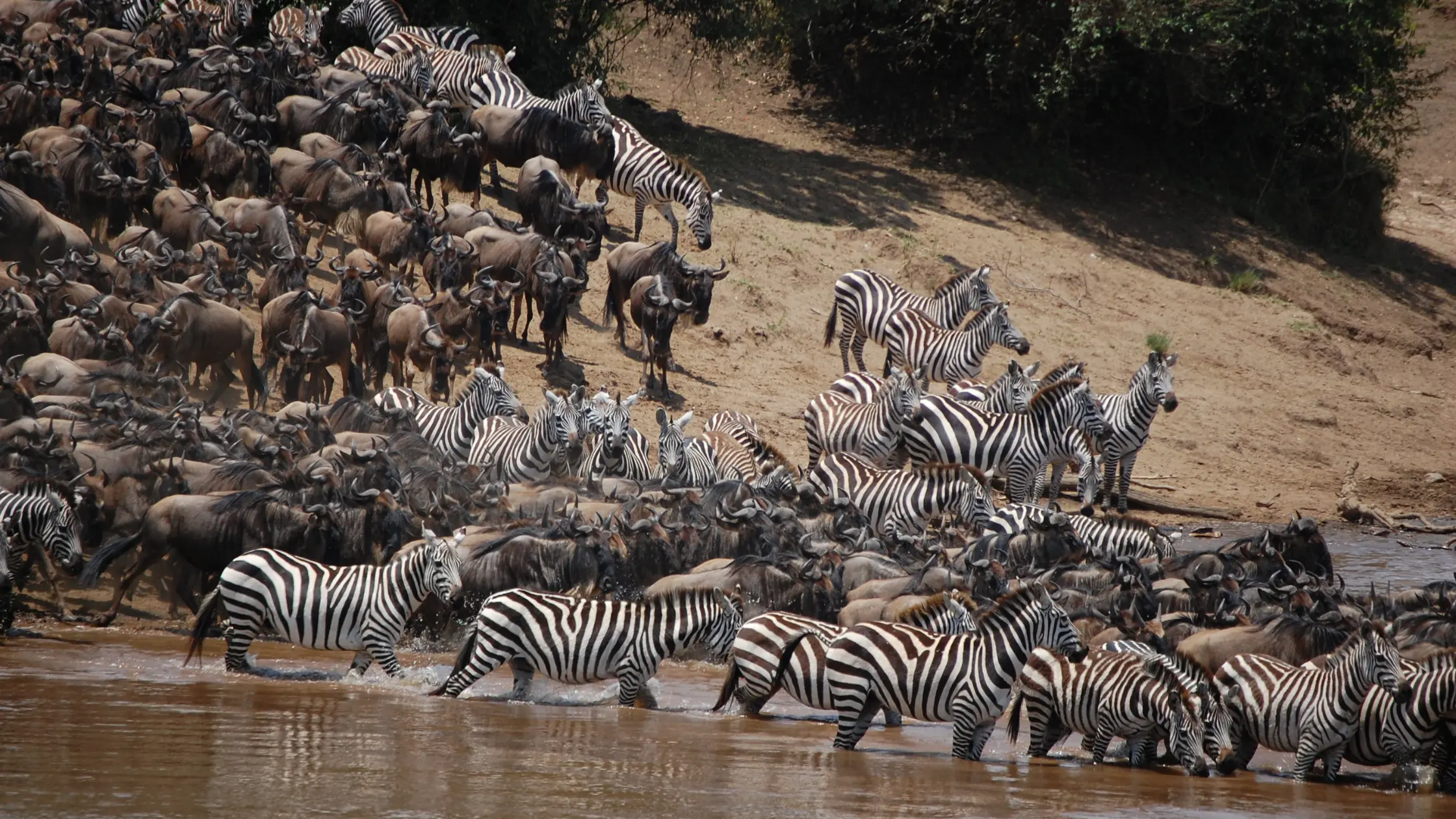
Picture the Maasai Mara in late afternoon light: thousands of wildebeest stretched across the plains in a single moving column, zebras threaded through the herd, and a line of vultures circling a ridge where a pride of lions is watching it all happen. That is the Great Migration, and it is the single biggest reason most first-time safari travellers choose Kenya.
But the Great Migration is not one event, and it is not only one river crossing. It is a year-round movement of more than a million wildebeest, plus large numbers of zebra and gazelle, across the Serengeti-Maasai Mara ecosystem in Kenya and Tanzania. The Kenya phase, centred on the Maasai Mara, is famous because this is where the dramatic Mara River crossings happen, usually between July and October.
This guide covers when the migration reaches Kenya, where to position yourself for the best chances, how the Mara River crossing actually works, how many days you need, what it costs, and how to plan the trip responsibly. Honest answer first: nothing about the migration is guaranteed on a fixed schedule, but with the right timing and the right base camp, your odds are very good.
Ready to start planning? Request a free Great Migration safari quote and tell us your travel dates, group size, and budget, and we will build a Maasai Mara itinerary around them.
What Is the Great Migration?
Quick Answer: The Great Migration is a year-round, circular movement of around 1.5 to 2 million wildebeest, plus hundreds of thousands of zebra and gazelle, across the Serengeti (Tanzania) and Maasai Mara (Kenya) ecosystem. In Kenya, the most famous phase happens in the Maasai Mara, usually from July to October, when herds arrive from the Serengeti and may attempt to cross the Mara River.
The migration is driven by one thing: grass and water. As the southern Serengeti plains dry out after the calving season (roughly January to March), the herds start moving north and west, following the rains toward fresh grazing. By the time the dry season tightens its grip on northern Tanzania, usually around July, the front of the herd reaches the Mara River, which forms part of the border between the Serengeti and the Maasai Mara.
A few things are worth understanding before you book anything:
- It is not a single day or a single show. The migration is happening somewhere in the ecosystem every month of the year.
- It is not exclusive to Kenya. Most of the herd spends most of the year in Tanzania, including the calving season around the Ndutu Plains.
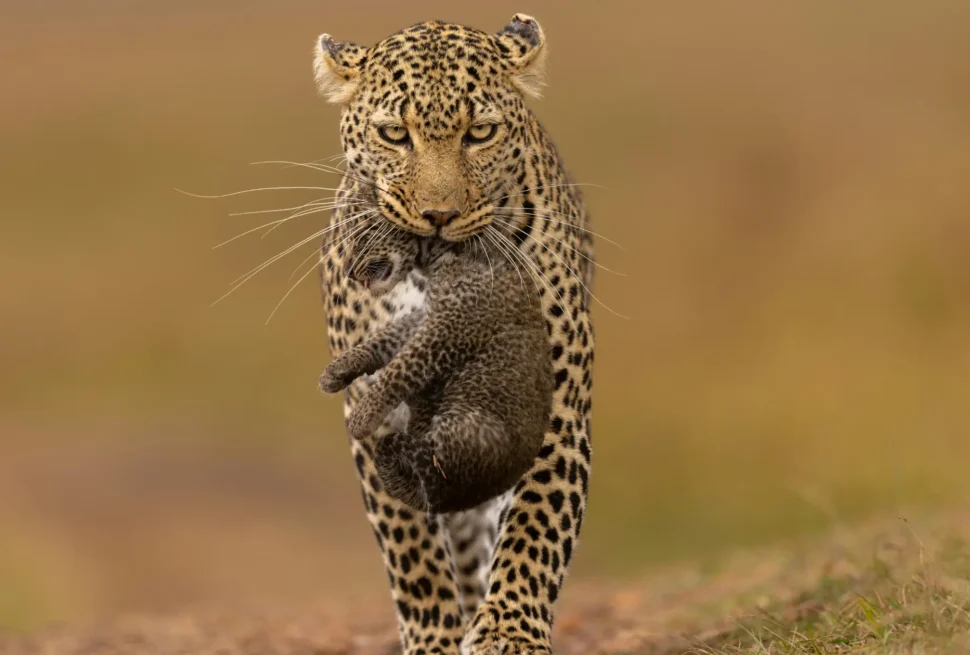
- It involves far more than wildebeest. Zebra, Thomson’s gazelle, and Grant’s gazelle move with the herd, and the predators (lions, cheetahs, leopards, hyenas) follow them.
- The Kenya phase is the most photographed because of the Mara River crossings and the open plains of the Maasai Mara and Mara Triangle.
- Above all, it is natural and unpredictable. Rainfall in any given year can shift the timing by weeks.
If you only remember one thing from this section, remember this: the migration is a living, weather-driven event, not a theatre production with a schedule. That is exactly what makes it special, and it is also why your choice of dates and base camp matters more than almost anything else in your safari plan.
When Is the Great Migration in Kenya?
The short answer: the Maasai Mara phase of the Great Migration usually runs from July to October, with August and September typically offering the strongest combination of herd numbers and Mara River crossing activity. Exact timing shifts year to year depending on rainfall in both Kenya and Tanzania, so treat any specific date as a probability, not a promise.
If river crossings are your main goal, our best time to visit Maasai Mara guide breaks down every month of the year in more detail, including the quieter, cheaper months that still deliver outstanding game viewing.
Great Migration in Kenya by Month
| Month | Migration Activity | Safari Experience | Best For |
| July | First major herds begin arriving from the Serengeti; early crossings possible | Good herd sightings, building energy, fewer vehicles than August | Early-season travellers who don’t mind some uncertainty |
| August | Peak herd density in the Maasai Mara; crossing chances are strong | Excellent wildlife viewing, but crossing points can get crowded with vehicles | First-timers, photographers, anyone prioritising the highest odds |
| September | Herds often still widespread across the Mara; crossings continue on both rivers | Outstanding game viewing with slightly thinner crowds than August | Travellers wanting strong odds with a bit more breathing room |
| October | Some herds begin drifting back toward Tanzania depending on rainfall | Late-season crossings still possible, especially early in the month | Flexible travellers and those hoping for better lodge availability |
July: Arrival of the Herds
July is when the front runners of the migration typically push north out of the Serengeti and into the Maasai Mara ecosystem, sometimes via the Sand River area first. Some years the first big crossings happen in early July, other years not until the final week of the month. If you book this period, go in with an open mind: you might catch one of the first crossings of the season with relatively few vehicles around, or you might spend a few days watching herds build up on the Tanzanian side before they commit to the river.
August: Peak Migration Season
August is statistically the most popular month, and for good reason. The herds are usually well established across the Maasai Mara and Mara Triangle, predator activity is intense, and crossing attempts happen regularly. The trade-off is crowding. At a popular crossing point in August, it is not unusual to see dozens of safari vehicles lined up along the riverbank. If you choose August, a camp close to the river saves you significant driving time each morning, and a guide who knows how to find quieter viewing angles makes a real difference.
September: Excellent Viewing and More Flexibility
September often rivals August for wildlife density, with the added benefit of slightly easier lodge availability and marginally smaller crowds at some crossing points. Herds frequently cross back and forth across the Mara River multiple times during this period as localised rain shifts the grazing on either side. For travellers who want strong odds without the absolute peak-season squeeze, September is consistently one of our top recommendations.
October: Late Migration and Southward Movement
By October, the migration story starts to shift. Some herds linger in the Mara, fattening up before the journey south, while others begin moving back toward the Serengeti, sometimes recrossing the river as they go. Crossings are still possible, especially in the first half of the month, and the resident wildlife in the Mara remains exceptional regardless. October can also bring better rates and availability at camps that were fully booked in August.
Can You See the Migration Outside July to October?
Yes, but with a different focus. The Maasai Mara has outstanding resident wildlife year-round: the Big Five, large lion prides, cheetah and leopard sightings, and over 500 recorded bird species in the reserve alone. What you generally will not see outside July to October is the dense cross-border herd and Mara River crossings, since most of the herd is in Tanzania for the rest of the year. If your dates are fixed outside this window, we can still build an excellent Maasai Mara safari around resident game, just without the migration as the centrepiece.
Not sure which month fits your dates and budget? Talk to our team and we will help you choose the right window for your Great Migration safari.
Where to See the Great Migration in Kenya
In Kenya, the Great Migration is concentrated in the Greater Maasai Mara ecosystem: the Maasai Mara National Reserve, the Mara Triangle in the reserve’s western section, and the private conservancies that border the reserve to the north and east. Where exactly you base yourself changes your experience significantly, so it is worth understanding the differences.
Best Places to See the Migration in Maasai Mara
| Area | Why Visit | Best For | Notes |
| Maasai Mara National Reserve (eastern sector) | Classic, open savannah safari with year-round resident wildlife and migration access | First-time visitors and classic safari experiences | The most popular area, so expect more vehicles in peak months |
| Mara Triangle | Scenic western sector close to key crossing areas along the Mara River | River crossing-focused travellers and photographers | Managed separately by the Mara Conservancy, generally fewer vehicles than the eastern sector |
| Private Conservancies (Mara North, Naboisho, Olare Motorogi, and others) | Lower vehicle density, night drives, walking safaris, and strong resident wildlife | Luxury travellers, honeymooners, and photographers who prefer a quieter pace | Conservancy access rules vary, and reaching some river crossing areas may require entering the main reserve |
| Mara River and Talek River crossing zones | The famous crossing points, used by herds when conditions are right | Photographers chasing crossing footage | Crossings are never guaranteed on any given day, in any given spot |
Maasai Mara National Reserve
This is the classic safari setting most people picture when they think of Kenya: rolling golden grassland, scattered acacia trees, and an enormous concentration of wildlife. The eastern sector of the reserve gives you access to large resident prides of lion, regular leopard and cheetah sightings, and, during migration season, a real chance of seeing herds moving across open ground. It is the right choice for first-time visitors who want the archetypal Maasai Mara experience and don’t mind sharing some of the more popular viewing areas during peak months.
Mara Triangle
The Mara Triangle sits in the reserve’s western sector, bordered by the Mara River to the east and the Oloololo Escarpment to the west. It is managed by the non-profit Mara Conservancy on behalf of the local county government, and it has a reputation for well-maintained roads, strong anti-poaching work, and fewer vehicles than the eastern side of the reserve. Because the Mara River runs along its edge, the Mara Triangle is one of the most strategic areas for travellers focused on crossing activity, though access points and driving distances from your camp still matter.
Private Conservancies Around the Maasai Mara
The conservancies that ring the reserve, places like Mara North, Naboisho, and Olare Motorogi, offer a different kind of safari: lower vehicle limits per sighting, night drives (which are not permitted inside the main reserve), guided walking safaris, and a closer relationship with the Maasai communities who own and lease the land. Wildlife viewing in the conservancies is excellent year-round, and during migration season they offer a genuinely quieter alternative to the busiest reserve roads. The trade-off is that some of the most active river crossing zones sit inside the main reserve, so a conservancy-based itinerary may need to include planned entries into the reserve itself to chase crossing activity.
Mara River Crossing Points
Crossing points along the Mara and Talek Rivers shift from year to year and even day to day, depending on water levels, herd pressure, and where the grass is greenest on either bank. Experienced guides watch herd behaviour closely: a large group gathering and pacing along a riverbank for hours is often a sign that a crossing may be building, though it can just as easily disperse without anyone entering the water.
A good migration safari should never be built around the promise of a “guaranteed crossing point.” Instead, it should give you enough time in the right general area, with a flexible itinerary, so your guide can follow what the herds are actually doing on the days you are there.
What Is the Mara River Crossing?
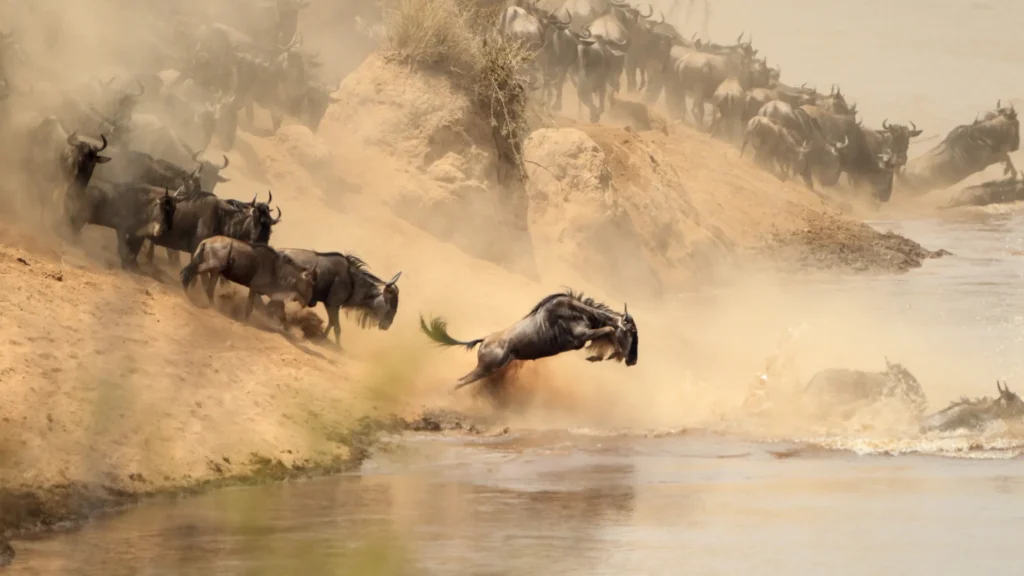
Quick Answer: The Mara River crossing is when wildebeest, zebra, and gazelle attempt to cross the Mara River (or its tributary, the Talek River) during the Great Migration in Kenya. It is one of the most dramatic wildlife events in Africa, but it is entirely unpredictable. Crossings depend on herd movement, water levels, weather, and grazing conditions on either bank, and there can be days with no crossing at all.
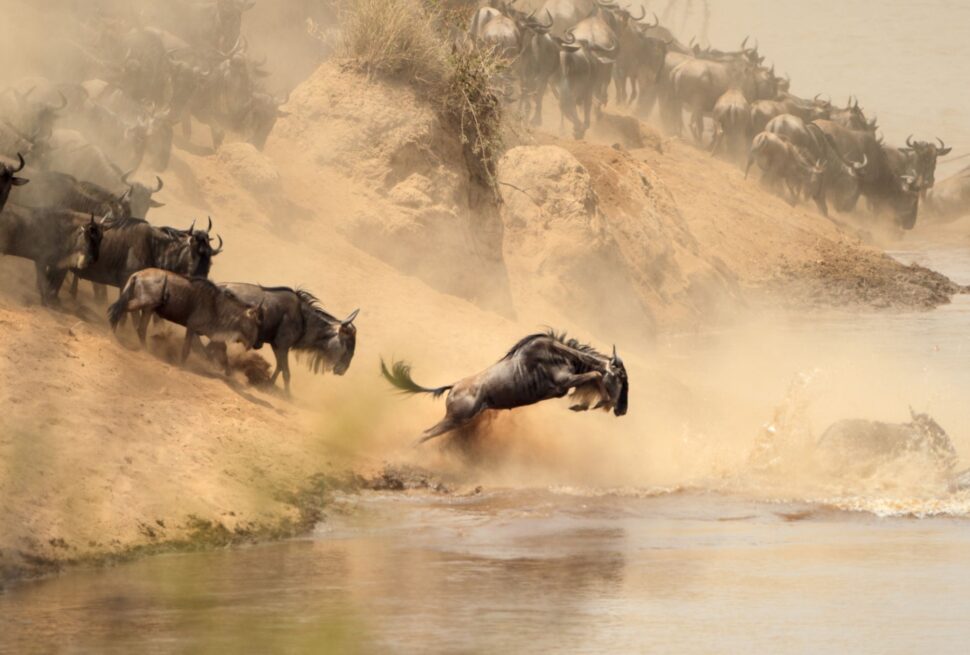
The crossing itself can be a slow build or a sudden rush. Herds often gather at the water’s edge in their thousands, sometimes waiting for hours, sometimes for a day or more, before the first animals commit to entering the river. Once the front animals move, the rest can follow in a chaotic wave, with steep, muddy banks, strong currents, and Nile crocodiles all adding to the danger.
It is intense to watch. Crocodiles that have spent months conserving energy make their move, weaker animals can be swept downstream, and predators wait on both banks for stragglers. It is nature at its most dramatic, and also at its most unscripted.
A few honest points worth knowing before you go:
- Crossings can happen at any time of day, though many occur in the morning.
- Some days bring no crossing at all, even in peak season.
- A “false start,” where the herd approaches the water and then retreats, is common.
- Crowding of vehicles at popular crossing points can affect both your view and the animals’ behaviour, which is why responsible guiding matters.
- Patience is part of the experience. Guides who have spent years reading herd behaviour will often position you well before anything happens, but even they cannot predict the exact moment.
Is the Great Migration Guaranteed?
No, and any operator who tells you otherwise is overselling. The Great Migration is a natural wildlife movement, not a scheduled performance, and the Mara River crossing in particular is one of the least predictable parts of it.
What you can do is stack the odds in your favour:
- Travel during July to October, when the herds are most likely to be in or near the Maasai Mara.
- Spend at least 3 to 4 nights in the Mara, since more days mean more chances and more flexibility to chase herd movement.
- Choose a strategic base, whether that is near the Mara Triangle, in a conservancy with planned reserve access, or in the eastern sector close to known activity.
- Travel with experienced local guides, who read dust clouds, vulture activity, and herd behaviour far better than any app or forecast.
- Keep your itinerary flexible, so your guide can adjust which area you visit based on what is happening that morning.
- Go in with realistic expectations, understanding that wildlife sightings change daily and even the best-positioned safaris sometimes miss a crossing.
A responsible tour operator should never promise you a river crossing on a specific date. What we can promise is helping you choose the season, the area, and the safari length that gives you the strongest realistic chance, and an outstanding safari experience even on the days the herd stays on the far bank.
How Many Days Do You Need for a Great Migration Safari?
For most travellers, 4 to 5 days in the Maasai Mara is the sweet spot for a migration-focused safari. Here is how different lengths compare.
Safari Length Comparison
| Safari Length | Pros | Cons | Best For |
| 3 Days | Quick, more affordable, works well as part of a wider trip or with a fly-in connection | Limited flexibility; one bad weather day can significantly cut into game-drive time | Travellers with limited time or those flying in for a short add-on |
| 4 Days | Good balance of cost and game-drive time; allows for a full day dedicated to migration tracking | Still relatively selective; less room to “wait out” quiet days | First-time travellers wanting a solid migration experience |
| 5 Days | Stronger odds of catching river activity; time to explore both reserve and conservancy areas | Higher overall cost than a 3- or 4-day trip | Photographers, families, and honeymooners who want to avoid feeling rushed |
| 7 Days | A complete Kenya safari combining the Mara with other destinations | Requires more time off and a bigger overall budget | Travellers who want to see the migration as part of a fuller Kenya itinerary |
If you are short on time, a 3-day Maasai Mara fly-in safari gets you into the heart of the action quickly. For most migration-focused travellers, our 6-day Maasai Mara migration safari is built specifically around giving the herds time to do what they do.
Best Great Migration Safari Itinerary Ideas
4-Day Maasai Mara Migration Safari
- Day 1: Nairobi to Maasai Mara (road or fly-in)
- Day 2: Full-day game drive across the reserve
- Day 3: Migration tracking, with time spent in the Mara River area
- Day 4: Morning game drive, then return to Nairobi
This works well for travellers with limited time, especially when paired with a morning flight from Wilson Airport to cut driving time.
5-Day Maasai Mara Migration Safari
- Day 1: Nairobi to Maasai Mara
- Day 2: Full-day game drive
- Day 3: Mara River area and migration tracking
- Day 4: Conservancy game drive for a change of pace and lower vehicle density
- Day 5: Final morning game drive, return to Nairobi
This is the itinerary we recommend most often to first-time migration travellers, and it forms the basis of our 6-day Maasai Mara migration safari, which adds an extra buffer day for flexibility.
7-Day Kenya Migration Safari
- Day 1: Arrive Nairobi
- Day 2: Nairobi to Lake Naivasha or Lake Nakuru
- Day 3: Transfer to Maasai Mara
- Day 4: Full-day migration safari
- Day 5: Mara River and big cat tracking
- Day 6: Optional hot air balloon safari or Maasai cultural visit
- Day 7: Return to Nairobi
For travellers who want to see more of Kenya alongside the migration, our 4-day Maasai Mara and Lake Nakuru safari and 7-day highlights of Kenya safari both make excellent starting points that we can extend or adjust around migration timing.
Want us to build a custom version of any of these? Request a custom Kenya safari quote and tell us your dates and travel style.
How Much Does a Great Migration Safari in Kenya Cost?
Migration-season pricing follows the same broad tiers as the rest of the Kenya safari market, but expect to pay toward the higher end of each tier during July to October, since this is peak season for park fees, conservancy fees, and accommodation rates alike. For a full breakdown of how these numbers add up, see how much a Kenya safari costs.
Budget safari: Built around shared transport, budget camps or basic tented accommodation, and group departures. This is the most affordable way to experience the migration, though comfort and exclusivity are limited. Our budget safari in Kenya guide covers how to keep costs down without missing the highlights.
Mid-range safari: The most popular choice for migration travellers. Usually includes comfortable tented camps or lodges, private or semi-private vehicles, and a well-located base near the action.
Luxury safari: Premium camps, fly-in transfers, private guides, conservancy stays, and high-end service. Many of the most sought-after migration camps near the Mara River sit in this tier and book out 9 to 18 months ahead for peak weeks.
What actually moves the price:
- Travel month (August and September command the highest rates)
- Number of days
- Lodge or camp category
- Private versus group safari
- Road safari versus fly-in safari
- Park fees, which run $200 per person per day in the Maasai Mara from July to December
- Conservancy fees, typically $80 to $150 per person per day, often bundled into camp rates
- Optional hot air balloon safari, generally $450 to $580 per person
- Group size and vehicle type
Park fees and conservancy rates can change, so always confirm current figures before booking. The Kenya Wildlife Service publishes official park fee schedules, and we double-check these before quoting any itinerary.
For an accurate price based on your dates, group size, comfort level, and preferred travel style, request a custom Great Migration safari quote and we will come back with a personalised itinerary.
Road Safari vs Fly-In Safari for the Great Migration
Road Safari from Nairobi
A road safari to the Maasai Mara typically takes 5 to 6.5 hours from Nairobi, covering 225 to 275 kilometres depending on the route and road conditions. It is the more affordable option, and the drive itself, particularly through the Mau Escarpment, is scenic in its own right. Road safaris work well for budget and mid-range travellers, families, and groups who don’t mind the travel time and want to keep costs down.
Fly-In Safari to Maasai Mara
Scheduled flights from Wilson Airport to airstrips near the Maasai Mara take around 45 minutes, cutting a full day of driving down to less than an hour each way. This is the preferred option for luxury travellers, honeymooners, older travellers, and anyone with limited time who wants to maximise hours actually spent in the Mara. Bush flight operators such as Air Kenya, Safarilink, and Governors Aviation typically enforce a 15 kg soft-bag luggage limit, and Wilson Airport requires a physical passport at check-in, so leave the digital copy at home.
Road Safari vs Fly-In Safari
| Factor | Road Safari | Fly-In Safari |
| Travel time from Nairobi | 5 to 6.5 hours each way | Around 45 minutes each way |
| Cost | Lower overall cost | Higher overall cost |
| Scenery | Scenic overland route through the Rift Valley | Aerial views of the Mara on approach |
| Best for | Budget and mid-range travellers, families, groups | Luxury travellers, honeymooners, short trips |
| Luggage | Standard luggage allowances | 15 kg soft-bag limit, physical passport required |
Best Safari Activities During the Great Migration
The migration is the headline act, but it is far from the only reason to spend several days in the Maasai Mara during peak season.
Game drives: Morning, afternoon, and full-day game drives are the backbone of any migration safari, and the best sightings often happen in the early morning and late afternoon light.
Hot air balloon safari: A sunrise balloon flight over the plains, often followed by a champagne bush breakfast, is one of the most memorable ways to see the scale of the herds from above. Balloon safaris should be booked early during migration season, as space fills up fast.
Wildlife photography: Migration season rewards patience, a long lens, and good positioning. Our wildlife photography safaris are built around getting you into position before the light and the action peak.
Big cat viewing: Lions, cheetahs, leopards, hyenas, and jackals all follow the herds closely, and migration season often brings some of the most dramatic predator activity of the year. Our Big Five safaris cover this in more depth.
Maasai cultural experience: A respectful, community-supportive visit to a Maasai village offers insight into the people who have lived alongside this ecosystem for generations. These visits should always be arranged through reputable operators who ensure the community benefits directly.
Sundowners and scenic bush experiences: An evening drink overlooking the plains as the light fades is a small thing, but it is often the moment that sticks with travellers most, especially honeymooners and luxury travellers.
Great Migration Safari Tips for First-Time Visitors
- Book early. July to October is high season, and the best camps near the river fill up 9 to 18 months ahead.
- Spend at least 3 nights in the Maasai Mara so you have more than one shot at the action.
- Do not expect a river crossing on demand. Go in with realistic expectations and you will enjoy every other moment far more.
- Choose your camp location carefully, since proximity to the river or to the conservancies shapes your whole experience.
- Carry binoculars and a good camera with a zoom lens. Distances in the Mara are often greater than they look.
- Pack neutral safari clothing in khaki, olive, and beige tones. Camouflage-patterned clothing is illegal for civilians to wear in Kenya, so leave it at home.
- Be patient during game drives. Some of the best sightings happen after long stretches of apparent quiet.
- Respect park rules and wildlife distance, including the 50 km/h speed limit and the ban on off-road driving in the main reserve.
- Consider travel insurance that covers medical evacuation, since costs without cover can run into thousands of dollars.
- Work with a local safari planner who understands the Mara’s rhythms, rather than a generic booking platform.
What to Pack for a Kenya Migration Safari
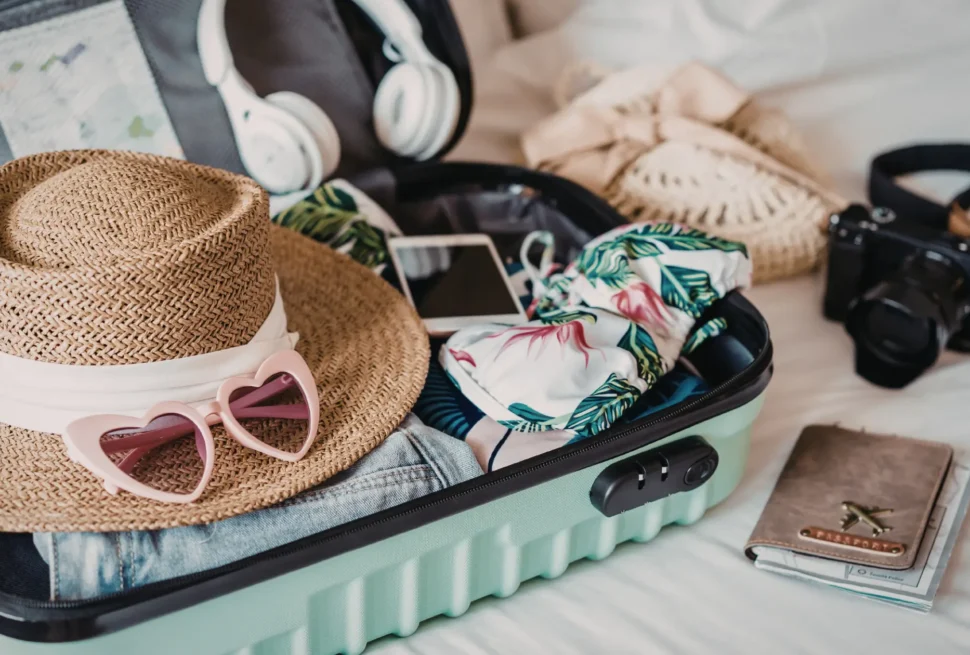
A migration safari rewards practical packing over fashion. The essentials:
- Neutral, lightweight clothing for daytime game drives
- A warm layer for early morning drives, which can be surprisingly cold even in dry season
- Comfortable, closed walking shoes
- Sunhat and sunglasses
- High-SPF sunscreen
- Binoculars (ideally one pair per person)
- Camera, spare batteries, and memory cards
- A power bank, since charging points can be limited at some camps
- Travel documents, including your passport and Kenya eTA confirmation
- Insect repellent
- A reusable water bottle
- Any personal medication you need, in your carry-on
If you are flying between camps on a bush flight, remember the 15 kg soft-bag limit and pack accordingly.
Great Migration Kenya vs Tanzania: Which Is Better?
Neither country “owns” the migration. It is one continuous cycle across the Serengeti-Mara ecosystem, and the right country depends on what you most want to see.
Kenya is best for:
- The July to October migration window and the famous Mara River crossings
- Classic Maasai Mara safaris
- Combining the migration with Nairobi, Amboseli, Lake Nakuru, or a beach extension on the coast
- Shorter, more affordable safari logistics from Nairobi
Tanzania is best for:
- The calving season, roughly January to March, in the southern Serengeti
- Serengeti-focused safaris across vast, less-crowded plains
- Longer, multi-region migration routes
- Combining the Serengeti with the Ngorongoro Crater
For travellers specifically searching for dramatic river crossing scenes, the Maasai Mara between July and October remains one of the best choices anywhere in East Africa. If your priority is the calving season and newborn wildebeest surrounded by predators, Tanzania’s southern Serengeti has the edge. Neither is wrong; they’re just two chapters of the same migration, on opposite sides of the border.
Is the Great Migration Worth It?
Yes, with one honest caveat: it is worth it if you understand it as a natural wildlife experience, not a guaranteed performance.
Even on the days when no crossing happens, the Maasai Mara during migration season delivers some of the best wildlife density on the planet. Massive herds spread across open plains, intense predator activity, dramatic skies, and photography opportunities at every turn. Travellers who arrive with realistic expectations almost always leave saying the trip exceeded what they imagined, crossing or no crossing. The wildlife doesn’t know how much you paid, and it doesn’t perform on a schedule, but the sheer scale of what is happening around you during these months is genuinely extraordinary.
Responsible Migration Safari Travel
Migration season puts real pressure on the Maasai Mara ecosystem, and how visitors behave matters.
- Do not pressure your guide to chase or crowd animals for a better view.
- Avoid blocking known crossing routes or river approaches, even if it means a less perfect photo angle.
- Follow reserve and conservancy rules, including speed limits and off-road driving restrictions.
- Choose operators who train their guides in responsible wildlife viewing.
- Respect Maasai communities and their land, especially around conservancies and village visits.
- Support conservation-linked tourism, since conservancy fees directly fund anti-poaching and habitat protection.
- Keep noise low around wildlife, particularly at sensitive moments like a building crossing.
- Never ask your guide to drive off-road where it is prohibited, both for the safety of the wildlife and to avoid fines that can run KES 10,000 or more.
At Imela Tours and Travel, we plan every migration safari with these principles built in, because protecting the Mara is what keeps this experience possible for the travellers who come after you. For more on the conservation work happening across the ecosystem, the Mara Conservancy publishes regular updates on its anti-poaching and habitat programmes in the Mara Triangle.
Frequently Asked Questions About the Great Migration in Kenya
What is the best month to see the Great Migration in Kenya?
The best months are generally July through October, with August and September often offering the strongest combination of herd numbers and Mara River crossing activity. Exact timing shifts each year depending on rainfall.
Where can I see the Great Migration in Kenya?
The best place is the Greater Maasai Mara ecosystem, including the Maasai Mara National Reserve, the Mara Triangle, and the surrounding private conservancies. Our Maasai Mara destination page covers each area in more detail.
Is the Mara River crossing guaranteed?
No. River crossings are unpredictable and depend on herd movement, rainfall, water levels, and grazing conditions on either bank. Some days bring multiple crossings, and others bring none.
How many days do I need for a Great Migration safari?
A 4- to 5-day Maasai Mara safari is ideal for most travellers, giving you enough game drives and flexibility to follow herd movement. A 3-day safari is possible, especially with a fly-in connection, but offers less room for a quiet day.
Is July or August better for the Great Migration?
Both can be excellent. July often marks the early arrival of the herds, with potentially fewer vehicles, while August is usually peak season with the highest herd density and strong crossing activity, along with the biggest crowds.
Can I see the Great Migration from Nairobi?
No, not directly. You need to travel from Nairobi to the Maasai Mara, either by road (5 to 6.5 hours) or by a short flight (around 45 minutes) from Wilson Airport.
Is Maasai Mara crowded during migration season?
Yes, popular areas, especially well-known crossing points, can get busy during August and September. Staying in a strategic camp, considering the Mara Triangle or a conservancy, and travelling with experienced guides all help manage this.
Can children go on a Great Migration safari?
Yes. A migration safari can be very family-friendly when planned around suitable accommodation, realistic drive times, and guides who know how to keep younger travellers engaged. Our family safari options can be adapted to migration timing.
What animals are part of the Great Migration?
The migration mainly involves wildebeest, zebra, and gazelle, travelling alongside predators and scavengers including lions, cheetahs, leopards, hyenas, jackals, and Nile crocodiles in the rivers.
Should I book a private safari or a group safari?
A private safari offers more flexibility, which is especially useful during migration season when chasing herd movement matters. Group safaris are more affordable but may follow a fixed schedule with less room to adapt.
For the latest official park fee schedules and travel advisories, visit the Kenya Wildlife Service and Magical Kenya.
Related Reading from Imela Tours & Travel:
- How Much Does a Kenya Safari Cost in 2026?
- Best Time to Visit Maasai Mara in 2026
- Best Kenya Safari Packages from Nairobi in 2026
- Budget Safari in Kenya: How to Travel Cheap Without Missing Out
Plan Your Great Migration Safari with Imela Tours and Travel
Ready to witness the Great Migration in Kenya for yourself? Let Imela Tours and Travel help you plan the right Maasai Mara safari based on your travel dates, budget, group size, and preferred comfort level. Whether you want a budget adventure, a family safari, a luxury migration experience, or a private guided tour, we will help you turn every trip into an adventure.